

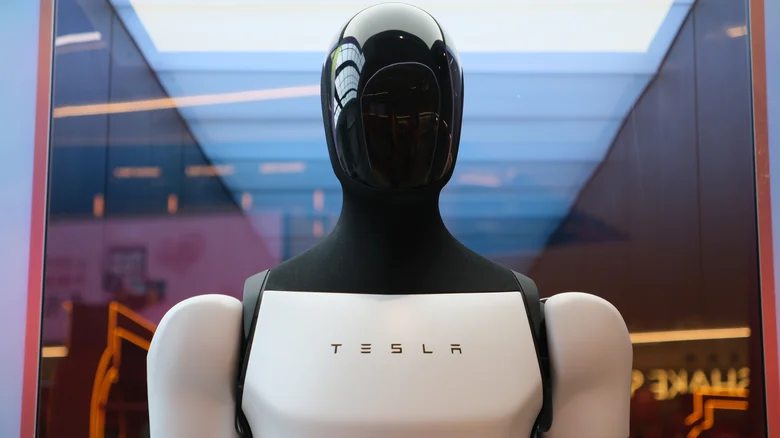
Tesla’s ambitious Optimus humanoid robot project captured global attention during the company’s “Autonomy Visualized” showcase in Miami in early December 2025, but a leaked video turned the event into unintended comedy gold. The footage shows an Optimus unit autonomously handing out water bottles to attendees before clumsily knocking over its display, raising its arms in apparent shock, and tumbling backward in a flailing heap of metal limbs. What spread rapidly across social media as prime slapstick material also ignited serious criticism, exposing fundamental challenges in Tesla’s robotics ambitions and casting doubt on Elon Musk’s grandiose revenue predictions for the technology.
Longtime observers recognize this mishap as symptomatic of broader struggles within Tesla’s humanoid program, where flashy demonstrations often mask underlying technical limitations and production delays. Musk has repeatedly positioned Optimus as a multi-trillion-dollar opportunity, predicting in February 2025 that the bipedal robot alone could generate over $10 trillion in revenue—a claim increasingly at odds with persistent execution gaps. As competitors from Silicon Valley giants to Chinese robotics firms accelerate their own programs, Tesla faces mounting pressure to convert viral moments into viable products amid growing skepticism about humanoid viability.
The viral tumble exposes deeper control issues
The water bottle fiasco transcends mere physical comedy, with analysts speculating the robot’s dramatic gestures—reaching toward its “face” before collapse—mirror an operator removing a VR headset rather than genuine autonomous confusion. This interpretation aligns with Tesla’s documented history of teleoperation during public showcases, including the October 2024 “We, Robot” event where remote pilots went undisclosed. Such “Wizard of Oz” tactics create illusion of autonomy while masking the sophisticated human intervention required for fluid performance in unstructured environments.
Tesla maintained silence on the incident, but Musk’s recent boasts paint contrasting pictures: October 2025 investor calls highlighted Optimus “doing kung fu” at the Tron premiere with Jared Leto, while earlier X posts insisted martial arts demos ran pure AI without teleoperation. Production realities tell different stories—a July 2025 report revealed Tesla hundreds short of its 5,000-unit 2025 target, prompting November announcements shifting Gen 3 manufacturing to 2026 with $20,000 retail pricing. These delays underscore the chasm between demonstration reels and factory-scale reliability.
Multi-billion-dollar rivals intensify competition
Humanoid robotics emerges as 2025’s fiercest AI battlefield, with Morgan Stanley forecasting a $5 trillion market and 1 billion units by 2050. Musk envisions Optimus catapulting Tesla to $25 trillion valuation, but domestic challengers crowd the field: Figure AI boasts backing from OpenAI, Nvidia, Microsoft, and Amazon; Meta commits billions to “Metabot” embodiment; Alphabet’s March 2025 Gemini Robotics initiative targets embodied AI software; Boston Dynamics advances Hyundai-funded agility. Each brings specialized strengths Tesla must match across hardware, software, and scaling.
China poses Tesla’s existential threat, treating embodied AI as national priority fueling manufacturing dominance and military modernization. Unitree’s $16,000 G1 demonstrates dexterous movement evading U.S. firms, while EngineAI Robotics and UBTech leverage Beijing’s aggressive subsidies. 2025 saw 150 Chinese manufacturers secure $5 billion investment—matching prior half-decade totals—as state strategy mirrors EV playbook dominance. Tokyo’s December 2025 International Robot Exhibition showcased Unitree G1s boxing competitively, signaling dexterity gaps Tesla still navigates.
Technical realities temper industry hype
Beneath billionaire predictions and national strategies lies profound engineering complexity separating viral videos from deployable products. Wall Street Journal reports highlight AI insiders cautioning against conflating acrobatic demos with reliable utility—Optimus tumbles illustrate physics, balance, and real-time cognition challenges persisting despite years of development. Battery life, joint durability, sensor fusion, and cost-effective manufacturing remain unsolved at scale, while teleoperation dependencies undermine autonomy claims essential for commercial viability.
Tesla’s path demands simultaneous mastery of electric actuation, neural network control, cloud orchestration, and high-volume factories—competencies overlapping vehicle expertise yet amplified by humanoid unpredictability. Chinese scale advantages meet American software sophistication, with neither demonstrating breakaway leads. Investors increasingly distinguish between perception systems powering self-driving cars and full-body embodiment requiring decade-level breakthroughs across mechanical, electrical, and computational domains.
Robot economy timeline extends beyond hype cycles
Optimus mishaps humanize technology still crawling toward economic relevance, where warehouse sorting or eldercare assistance represents nearer-term value than sci-fi companions. Musk’s timeline compression—low-volume 2026 sales evolving toward trillion-scale impact—requires sustained execution amid talent wars, supply constraints, and regulatory scrutiny over job displacement. Chinese state capitalism accelerates iteration but risks property bubbles if capabilities lag investment fervor.
Western firms emphasize deliberate progress: Figure AI prioritizes enterprise pilots; Boston Dynamics perfects dynamic stability; Apptronik partners NASA for astronaut assistance. Multi-year technology plateaus likely precede consumer inflection, with 2030s marking realistic commercialization absent miraculous convergence. Optimus water bottle chaos ultimately reassures: humanoid revolution unfolds measured decades, not imminent disruption, allowing society preparation time matching technical maturation.