

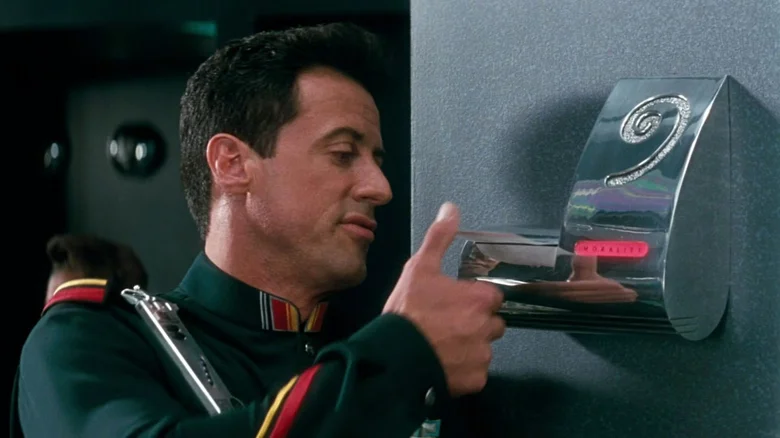
For anyone who grew up in the 1990s, Marco Brambilla’s wild sci-fi action film “Demolition Man” was an unforgettable part of pop culture. Released in 1993, the movie was an eccentric blend of over-the-top action, futuristic speculation, and razor-sharp satire. Headlined by Sylvester Stallone as the unrelenting cop John Spartan and Wesley Snipes as the colorful villain Simon Phoenix, the film combined pure entertainment with surprisingly thoughtful glimpses into the future. What once seemed like ridiculous predictions about the year 2032 now feels eerily prescient—proof that sometimes, science fiction is simply years ahead of its time.
“Demolition Man” satirized a utopian future that had gone awry—a sanitized society obsessed with safety, political correctness, and technological control. Beneath the explosions and one-liners, Brambilla and writer Daniel Waters built a world where individuality and risk were replaced by regulation and automation. It was a comedy disguised as an action movie, but with enough sci-fi concepts to make tech futurists raise an eyebrow decades later. What once looked like cheesy Hollywood spectacle has aged into a strangely accurate commentary on life in the 21st century.
Technological Predictions That Came True
At first glance, “Demolition Man” seemed like standard Stallone territory—plenty of explosions, absurd machismo, and witty banter. But the film’s futuristic inventions were astonishingly forward-thinking. Many of its imagined technologies exist today in one form or another. Self-driving cars, once a joke in the movie’s spotless City of San Angeles, are now a reality thanks to companies like Waymo and Tesla. The voice-activated home systems seen in Stallone’s apartment mirror modern smart home assistants like Alexa and Google Home. Even GPS navigation and virtual video communication—then little more than sci-fi dreams—are now everyday conveniences.
The film also featured omnipresent surveillance, facial recognition systems, and digital communication devices that closely resemble modern tablets and smartphones. In the 1990s, when rotary phones still lingered in many households, these ideas felt almost utopian. Watching the movie today, however, audiences are more likely to smirk in recognition than laugh in disbelief. “Demolition Man” didn’t just predict gadgetry—it foresaw the way technology would reshape human behavior. From the rise of corporate homogenization to society’s growing discomfort with physical touch and confrontation, the movie’s absurd future isn’t so absurd anymore.
The Story Beneath the Spectacle
Beyond its wild predictions, “Demolition Man” succeeded as a creative twist on the classic good-versus-evil narrative. The story begins in 1996, as John Spartan is imprisoned in a cryogenic facility along with criminal mastermind Simon Phoenix. Four decades later, in the year 2032, both men are thawed in a peaceful society that has abolished violence, profanity, and even physical intimacy. When Phoenix escapes during a parole hearing, his unrestrained aggression wreaks havoc across San Angeles. Unable to handle him, the pacifist authorities reluctantly revive Spartan—the one man equipped with old-school instincts and muscle to stop the chaos.
Sandra Bullock’s bright-eyed performance as Lieutenant Lenina Huxley provided the perfect counterbalance to Stallone’s gruff demeanor. Her fascination with the “violent past” of the 20th century gave the movie much of its humor and charm. Rob Schneider contributed comic relief, while Wesley Snipes delivered one of the most flamboyant villain portrayals of the decade. His Simon Phoenix was a mixture of menace and mischief—a hyperactive tornado of energy that embodied all the chaos society tried to suppress. The contrast between Phoenix’s anarchy and the sterilized world around him is what gave the film its satirical punch.
A Cult Classic with Lasting Relevance
At the time of its release, “Demolition Man” wasn’t an immediate critical triumph. Reviews were mixed—some praised its inventiveness, while others dismissed it as too ridiculous for its message to land. Still, audiences embraced it for what it was: a big-hearted, self-aware action film that didn’t take itself too seriously. Earning over $159 million worldwide, the movie ultimately found its footing as a cult classic. Fans still quote its memorable dialogue and debate its bizarre mysteries—like the infamous “three seashells” used in place of toilet paper.
What continues to make “Demolition Man” resonate, however, is its underlying social commentary. Beneath the bursts of gunfire and witty exchanges lies a subtle warning about the dangers of control and conformity. The sanitized society of San Angeles may have eradicated crime and pollution, but at the cost of freedom, spontaneity, and passion. Stallone’s John Spartan isn’t just battling a foe—he’s fighting to reclaim humanity’s rough edges. In a world obsessed with optimization and caution, his crude charisma feels refreshingly real.
Why “Demolition Man” Feels So Relevant Today
Looking back more than thirty years later, the film’s predictions feel uncanny. Its depiction of virtual intimacy and digital disconnection mirrors our screen-centered lifestyles. Its portrayal of corporate mergers swallowing individuality echoes the dominance of tech giants today. Even its notion of language policing and sanitized communication feels alarmingly recognizable in modern social discourse. What seemed tongue-in-cheek in 1993 now reads as accidental prophecy.
Ultimately, “Demolition Man” is more than an entertaining relic of 1990s cinema—it’s a time capsule of cultural anxiety wrapped in blockbuster absurdity. Its blend of humor, spectacle, and foresight earns it a unique place among futuristic films. It reminds viewers that technology and perfection come at a price, and that a world without imperfection might also be a world without humanity. Whether you watch it for Stallone’s bravado, Snipes’ antics, or the oddball predictions that became reality, “Demolition Man” stands as one of the few sci-fi comedies that accidentally got the future right.