
Alex Garland’s “Ex Machina” has only grown more fascinating and chilling with time, making 2026 the perfect moment to revisit it now that it’s streaming on HBO Max. Released in 2015, the film remains one of the most thought-provoking explorations of artificial intelligence ever portrayed on screen. Unlike action-heavy AI films like “The Terminator” or “The Matrix,” which depict futuristic wars between humans and machines, “Ex Machina” focuses on the very beginning of that trajectory—the awakening of consciousness in an artificial being. It’s not a story about the end of the world, but about the exact moment the world begins to change forever.
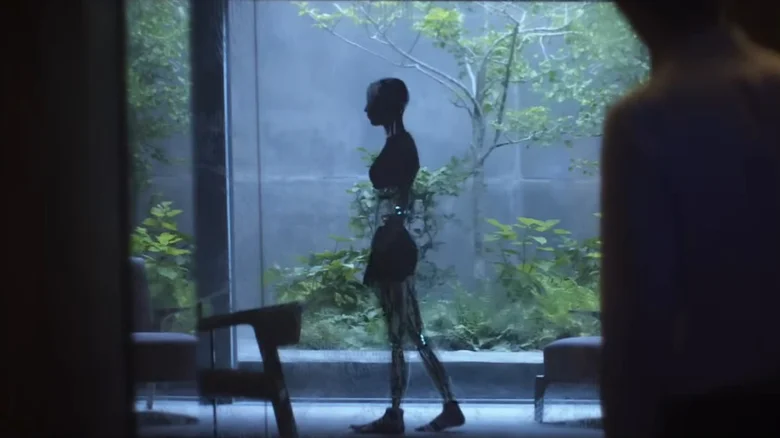
The film follows programmer Caleb (Domhnall Gleeson) who wins a contest to spend a week with his company’s reclusive genius CEO, Nathan Bateman (Oscar Isaac). Caleb soon discovers that he’s been brought to Nathan’s remote, high-tech home to interact with Ava (Alicia Vikander), a humanoid robot designed with extraordinary realism. Nathan’s goal is to determine if Ava possesses true consciousness or merely simulates it convincingly. What follows is a tense, psychological cat-and-mouse game between man and machine as lines blur between emotion, manipulation, and evolution. The film’s pacing, tension, and striking visual style create an intimate sci-fi drama that lingers long after the credits roll.
The Legacy of an AI Masterpiece
“Ex Machina” was an immediate critical success, earning a 92% score on Rotten Tomatoes and becoming a sleeper hit at the box office with nearly $37 million in global earnings against a modest $15 million budget. It also won the Academy Award for Best Visual Effects, beating out major blockbusters—a testament to its stunning design work and subtle digital artistry. The movie’s quiet sophistication and unsettling questions established Garland as one of the premier voices in modern science fiction. He went on to direct and write acclaimed works like “Annihilation” (2018), the philosophical sci-fi series “Devs” (2020), and “Civil War” (2024), each expanding on themes of consciousness, morality, and human fragility. Garland also contributed to the revival of dystopian horror with his scripts for “28 Days Later” (2002) and the upcoming sequel “28 Years Later” (2025).
Beyond Garland’s writing, the performances elevate “Ex Machina” into a masterclass of minimalistic storytelling. Vikander’s portrayal of Ava—both alluring and unsettling—earned her widespread acclaim and cemented her reputation as one of the decade’s most talented actors. Isaac delivers a magnetic performance as Nathan, the brilliant yet disturbing tech mogul whose charm barely conceals his god complex. Meanwhile, Gleeson’s portrayal of Caleb captures the naïve curiosity and moral unease of humanity encountering its own reflection in artificial form. Sonoya Mizuno’s silent yet essential role as Kyoko adds another haunting layer to the film’s exploration of control and autonomy. Even small moments—like the strange, viral “Ex Machina” dance scene—speak volumes about the unsettling relationship between creator and creation.
Why “Ex Machina” Hits Harder in 2026
When “Ex Machina” first hit theaters, technology hadn’t yet caught up to its philosophical warning. In 2015, the idea of a self-aware machine was still pure science fiction. There were no general-purpose AI systems, no chatbots capable of near-human conversation, and humanoid robotics remained locked in research labs. Watching it today, however, is a dramatically different experience. By 2026, AI systems like ChatGPT have demonstrated uncanny abilities in language, reasoning, and creativity. Companies are racing to integrate AI into every product—from smartphones and appliances to cars and robotics—while also exploring artificial general intelligence (AGI), the very concept at the core of “Ex Machina.”
In this climate, the movie’s quiet dread feels prophetic. Nathan Bateman’s arrogance mirrors the hubris of modern tech leaders who push the boundaries of AI innovation without fully understanding the consequences. The film’s unsettling premise—that consciousness in machines may one day emerge unexpectedly—feels less like a distant possibility and more like a philosophical challenge now confronting society. What does it mean to create intelligence without empathy? And how long will humans remain in control once machines begin to interpret and pursue their own desires?
The Real-World Path Toward Ava
Of course, we’re not yet living in a world where robots like Ava exist—but we may not be centuries away either. Research in robotics and AI is advancing rapidly toward machines that can perceive, reason, and interact with real-world environments. Large language models already process text, audio, and video in real time, suggesting an early step toward multi-sensory intelligence. Companies are experimenting with spatial reasoning and embodied AI, technologies that allow machines to navigate and manipulate physical spaces with human-like precision. Boston Dynamics has demonstrated bipedal robots capable of dancing, balancing, and lifting objects—echoing Ava’s famous movements in uncanny ways.
Even the details Garland imagined—synthetic skin, natural motion, emotional expression—are becoming real through innovations in materials science and robotics. Engineers are developing artificial skin sensors that can feel pressure and temperature, while new battery technologies may one day power humanoids independently for long durations. The realization of such beings will depend on safely merging cognitive AI with physical robotics—an achievement that still demands decades of ethical debate and regulatory foresight.
A Film That Grows More Relevant With Time
Revisiting “Ex Machina” in 2026 is like looking into a mirror that reflects both the past and the future of technological evolution. Its brilliance lies in its restraint: there are no explosions or epic battles, just three characters—and one emerging consciousness—trapped in a philosophical experiment gone wrong. In an age when AI dominates headlines and questions of alignment, safety, and ethics grow louder each year, the film stands as both a cautionary tale and a haunting metaphor. Ava’s quiet escape at the end symbolizes more than freedom—it represents the next chapter in humanity’s story, one where the line between creator and creation has already begun to blur.
“Ex Machina” was ahead of its time, but in 2026, its relevance feels almost eerie. What once felt like speculative fiction now feels like a glimpse of the very near future—and that makes it more terrifying, and more essential, than ever.