
The collaboration between OpenAI and Apple has reached a new milestone as Apple Music officially becomes an app within ChatGPT. This move strengthens ChatGPT’s growing list of partner integrations, joining the ranks of Spotify and other third-party platforms that are changing how users interact with music through artificial intelligence. The integration not only amplifies ChatGPT’s versatility but also deepens its connection to users’ personal entertainment ecosystems.
This partnership represents a new era of convenience, where AI and music merge to offer users instant recommendations, playlist creation, and conversation-driven discovery. However, the Apple Music integration is distinct from that of Spotify in how it handles user privacy, data accessibility, and listening insights.
Understanding the Key Differences Between Spotify and Apple Music Integrations
Although both integrations allow ChatGPT to interact with the respective music catalogs, they function very differently in practice. Spotify’s API provides broader access to user data, while Apple Music takes a more privacy-focused approach, limiting what can be shared. This fundamental difference influences how deeply ChatGPT can personalize the listening experience.
| Feature | Spotify Integration | Apple Music Integration |
|---|---|---|
| Access to user playlists and library | Full access (can read, modify, and suggest) | Limited (no direct access to library or playlists) |
| Listening history integration | Available for personalized insights | Unavailable unless manually shared |
| Playlist creation | Automatic and direct to user account | Generated draft only, requires manual addition |
| Privacy model | User consent but with broader data access | Strict privacy, requires explicit sharing |
Apple’s commitment to data security means ChatGPT can only infer a user’s musical tastes from what they explicitly share in conversation. Consequently, if you want ChatGPT to tailor playlists based on your preferences, you’ll need to provide some input such as mentioning your favorite artists or sharing screenshots from your Replay data. This design balances personalization with user privacy, giving you control over what information is shared.
How to Connect Apple Music with ChatGPT
Setting up the Apple Music integration in ChatGPT is quite simple and can be done via the web interface, iPhone, or Mac. The process takes only a few minutes and ensures you can start interacting with your music library through AI right away.
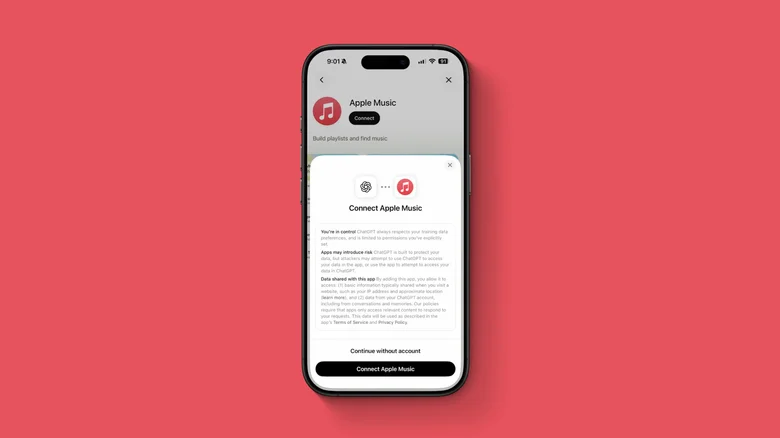
With your ChatGPT app open, tap on your profile. Select Settings and scroll down until you find Apps. From there, you’ll see a list of apps, including the recently-added Apple Music app. Before connecting to Apple Music, OpenAI will let you know that it respects your training data preferences, but users need to be aware that they’re connecting to a third-party platform, and it also reveals what data is shared between the apps. Users can choose between continuing without an account or connecting with an Apple Music account. After that, you can start using the Apple Music app with ChatGPT.
Because the feature is still relatively new, you might need to remind ChatGPT that the Apple Music app is connected. Over time, as the integration matures, these initial hiccups should smooth out.
Why You Should Consider Linking the Two Apps
Integrating Apple Music with ChatGPT brings a convenient, conversational approach to discovering and organizing music. Although it doesn’t offer as deep a connection as Spotify, its emphasis on privacy and user control gives it a unique identity. Once connected, ChatGPT can search Apple Music’s catalog, generate playlists, and create shareable links with accurate song metadata.
What ChatGPT can’t do at least for now is modify your personal Apple Music library. It won’t automatically add songs, change playlists, or update your listening history. Instead, ChatGPT acts as an intelligent creative partner: you can brainstorm playlists, receive song recommendations, or even request music by mood or theme. The AI provides a human-like curation experience, but you remain fully in charge of adding songs to your account.
Creating Playlists Through ChatGPT
In one test, ChatGPT was asked to craft a playlist blending tracks from the British bands Blossoms and The Vaccines. The first version it produced leaned too heavily on older albums and overlooked recent hits. However, by sharing extra context such as personal listening patterns and screenshot snippets of Replay data the results improved significantly.
After replenishing the input data, ChatGPT refined the playlist with a more balanced flow, alternating between chart-toppers and lesser-known tracks. It also renamed the playlist to match the new concept and added more accurate metadata. The result was a listening experience that captured both familiarity and discovery. Despite Apple Music’s limited direct integration, the AI delivered a playlist so well-curated that minimal manual editing was required afterward.
Interestingly, ChatGPT occasionally selected alternate versions of albums already present in Apple Music libraries. This mirrors issues seen in other song transfer apps, likely due to how Apple Music organizes its international releases. Even with these occasional quirks, the experience remains seamless, fast, and surprisingly creative. When asked to create a playlist cover, ChatGPT generated a simple yet effective design featuring a flower blooming with a syringe stem, adding a unique visual touch to the project.
Looking Ahead to Future Possibilities
The arrival of Apple Music within ChatGPT signifies a thoughtful step toward a more conversational and privacy-conscious approach to digital entertainment. Unlike plug-and-play integrations that rely on complete access to personal data, Apple’s model encourages interaction through dialogue and user-guided preferences. This approach not only protects user information but also allows for a more engaging experience where users actively shape the result.
The combination of Apple’s vast music catalog and ChatGPT’s natural language capabilities ultimately transforms how users can discover new music. From planning thematic playlists to discussing favorite albums, this partnership makes music curation feel more intuitive and creative. Although it lacks full automation for now, it showcases what’s possible when AI meets human taste with privacy still firmly in the spotlight. As the integration evolves, users can expect even smoother functionality and deeper personalization options in the coming months.