

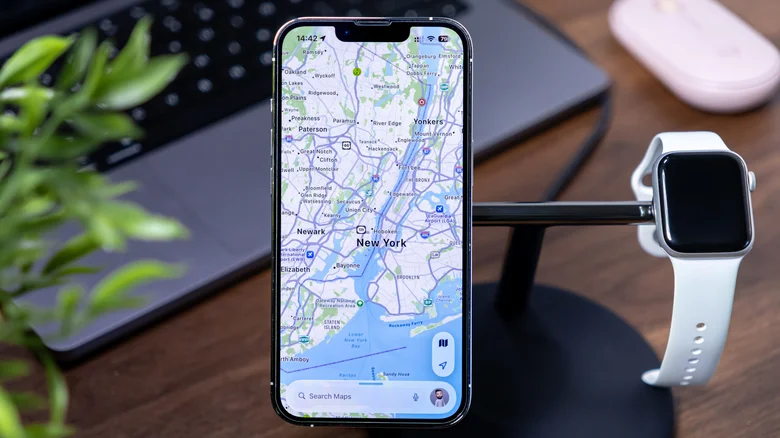
For iPhone users, the decision between Apple Maps and Google Maps for daily navigation has evolved from a simple choice based on reliability to a nuanced consideration of personal values and digital habits. A decade ago, Apple’s mapping service suffered from significant data inaccuracies, making Google Maps the undisputed leader. Today, both platforms have achieved near parity in core navigation functionality, offering comparable route accuracy, real-time traffic updates, and reliable estimated arrival times. The competition has shifted from a battle over basic utility to a contest of philosophy, ecosystem integration, and supplemental features. Your selection now hinges less on whether an app can get you from point A to point B and more on how it aligns with your priorities regarding privacy, discovery, and the digital environment you inhabit most. This makes understanding the distinct strengths and trade-offs of each service essential for making an informed choice.
Apple Maps: Privacy-Centric and Ecosystem-Integrated
If safeguarding personal data is a primary concern, Apple Maps presents a compelling advantage. Apple’s business model does not rely on advertising revenue derived from user profiling, which fundamentally shapes its approach to location data. The service employs techniques like “fuzzing,” which obfuscates the precise location of your searches after 24 hours, converting them to a less specific area. Crucially, Apple Maps does not require an Apple ID sign-in for core functionality, meaning your travel patterns and search history are not systematically linked to your identity to build a persistent profile. This privacy-first stance is a core differentiator. Beyond data protection, Apple Maps excels in delivering a streamlined, driver-focused interface. The design is intentionally clean, placing essential controls in the lower portion of the screen to maximize the map view. Navigation instructions are often phrased in a more natural, landmark-based language, such as “turn right after the gas station,” which many find easier to process while driving. For users deeply invested in Apple’s ecosystem, the integration is seamless. It works flawlessly with Siri, delivers haptic turn-by-turn directions to the Apple Watch, and can automatically mark your parked car’s location when used with CarPlay, creating a cohesive and convenient experience across devices.
Google Maps: The Comprehensive Discovery Platform
Google Maps’ greatest strength is its unparalleled scale and depth as a discovery tool. With over two billion monthly users across Android, iOS, and the web, it benefits from a vast network of real-time data contributions, which can enhance the accuracy of traffic conditions and business information globally. The app functions as a sophisticated search engine for the physical world, integrating detailed user reviews, photos, questions and answers, and real-time information like gas prices directly into the map interface. Its design encourages exploration, proactively surfacing nearby restaurants, attractions, and personalized recommendations based on your history. The most significant recent advancement is the integration of generative AI via Google’s Gemini technology. This transforms the app from a passive map into an interactive local guide. Users can now ask natural language questions like, “Find a kid-friendly Italian restaurant with outdoor seating,” and receive curated, summarized suggestions instead of manually sifting through endless listicles and reviews. This AI-powered conversational layer represents a major leap in usability for planning and discovery.
Evaluating the Core User Experience
When assessing pure navigation, both apps are highly competent. However, their approaches reflect their overarching philosophies. Apple Maps prioritizes a minimalist, unobtrusive experience that keeps the driver’s focus on the road. Google Maps offers a richer, more information-dense interface that can be invaluable for trip planning but may feel cluttered to some during active navigation. Features like offline maps, lane guidance, and speed limit indicators are now standard in both. The choice often boils down to whether you value a streamlined, integrated tool (Apple Maps) or a powerful, all-encompassing platform for exploration (Google Maps). For frequent travelers or those who frequently use non-Apple devices, Google Maps’ cross-platform consistency is a major practical benefit.
Making the Right Choice for Your Needs
Ultimately, the decision is personal and can even be situational. For daily commuting and errands within the Apple ecosystem, where privacy and a distraction-free interface are valued, Apple Maps is an excellent default. Its deep integration with iOS, CarPlay, and the Apple Watch creates a smooth, hands-free experience. Conversely, if you frequently research new destinations, rely on user-generated content like reviews and photos, or use a mix of Android and Apple devices, Google Maps remains the more versatile and powerful tool. Its AI-assisted search and massive database make it superior for planning trips, exploring unfamiliar cities, or finding specific types of businesses. Many users find value in maintaining both apps, using Apple Maps for everyday integrated navigation and switching to Google Maps for in-depth research and discovery. As both services continue to innovate—Apple with deeper ecosystem features and Google with advanced AI—this dynamic competition ensures that users ultimately benefit from constant refinement and powerful choices in how they navigate their world.