

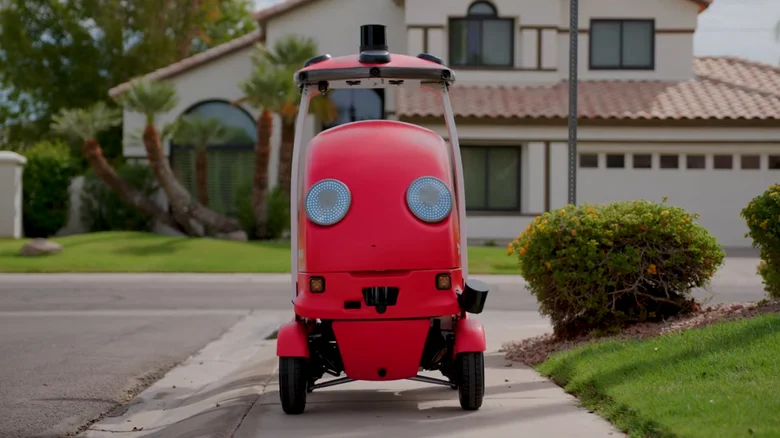
DoorDash has entered the autonomous delivery era with Dot, a compact robot designed for sidewalk, bike lane, and road navigation in local neighborhoods. Standing nearly five feet tall and weighing 350 pounds, Dot resembles a friendly red food box on wheels, complete with glowing LED “eyes” for approachability. Founded in 2013, DoorDash has expanded globally using gig workers for flexible deliveries, but Dot represents a shift toward automation amid surging order volumes and labor debates.
DoorDash Dot Specifications and Capabilities
Dot measures about 4.5 feet tall, one-tenth the size of a car, enabling it to squeeze through doorways, driveways, and tight spaces while reaching speeds up to 20 mph. It carries up to 30 pounds—enough for six large pizzas—with swappable inserts like cupholders or coolers for versatile cargo. Powered by a swappable battery lasting six hours per charge, the all-electric design reduces emissions and road congestion compared to traditional vehicles.
Navigation relies on eight external 360-degree cameras, four radar units, three high-resolution LiDAR sensors, and GPS, allowing real-time obstacle avoidance and route optimization. DoorDash’s AI dispatcher integrates Dot into its broader ecosystem, pairing orders with robots, drones, or human Dashers based on distance, complexity, and cost. Initial pilots in Tempe and Mesa, Arizona, target expansion to Phoenix metro by year’s end, serving 1.6 million residents.
Operational Workflow and Benefits
AI dispatches Dot from merchants to customers for short-haul orders, handling pickups and drop-offs autonomously. The front-opening compartment ensures secure, contactless handoffs, while interior cameras verify delivery quality. Benefits include lower operational costs—no tips required—faster neighborhood trips preserving food temperature, and environmental gains from zero tailpipe emissions. DoorDash claims Dot’s robust build deters tampering, though field staff intervene if issues arise without remote control.
For consumers, Dot promises reliable service without human variability, while merchants gain efficiency for high-volume items. The robot complements rather than replaces gig workers, reserving humans for stairs, complex buildings, or oversized loads. Suburban focus addresses gaps in dense urban sidewalk bots, potentially lowering delivery fees long-term.
Challenges and Public Concerns
Despite promise, delivery robots face navigation hurdles like uneven sidewalks, curbs, or crowds, with past trials showing stalls that block paths—particularly problematic for wheelchair users. Dot’s road capability mitigates some issues but introduces traffic integration risks. Critics highlight job displacement for gig workers already facing instability, low pay, and few protections, echoing broader AI employment fears.
Vandalism remains a threat; incidents like Texas residents downing Amazon drones cite privacy from cameras and aesthetic clutter. Weather resilience, theft deterrence beyond size, and scaling production pose additional barriers. DoorDash must navigate regulations varying by city, balancing innovation with community acceptance.
Future Implications for Delivery Ecosystems
Dot signals DoorDash’s multi-modal vision: ground robots for suburbs, drones for air, humans for nuance. Partnerships like Coco Robotics inform design, with plans to replace costly LiDAR for affordability. Success could reshape local commerce, boosting merchant margins and consumer access while pressuring competitors to automate.
Public rollout will test viability amid polarized views—excitement for sci-fi convenience versus fears of dehumanized service. DoorDash emphasizes synergy with Dashers, but workforce transitions loom. As autonomy scales, expect refined UX, like interactive eyes signaling intent, fostering coexistence on shared paths.