

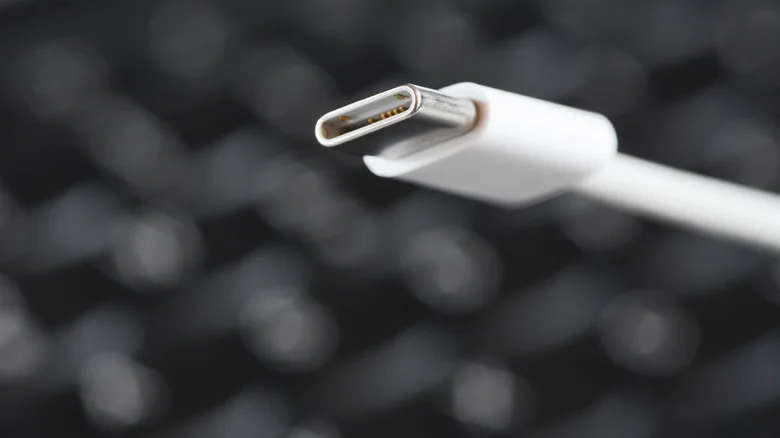
USB-C has achieved near-universal adoption across smartphones, laptops, tablets, and accessories in 2025, supporting 240W power delivery, 80Gbps data transfer (USB4), 8K video output, and audio return channel through a single reversible port. EU mandates enforce USB-C as mandatory charging standard for all devices under 100W by December 28, 2024, slashing e-waste by 11,000 tons annually while enabling slimmer designs without proprietary connectors. iPhone 15+ series, Galaxy S24 lineup, MacBook Air M3, and Surface Laptop 7 consolidate power/data/video into one port, eliminating cable clutter across 2.8 billion devices.
Technical Superiority Driving USB-C Dominance
USB-C’s 24-pin architecture delivers unmatched versatility: USB4 v2.0 achieves 80Gbps bidirectional throughput (40Gbps PCIe tunneling), Thunderbolt 5 integrates 120Gbps with DisplayPort 2.1 for triple-4K/120Hz or single-8K/60Hz displays. Power Delivery 3.1 enables 240W (48V/5A) fast-charging MacBooks in 28 minutes, Android phones 0-100% in 22 minutes, versus Lightning’s 27W cap.
Durability exceeds predecessors: 10,000+ insertion cycles (3x micro-USB), IP67 water resistance via e-marker chips, and symmetrical design eliminates orientation errors plaguing USB-A/micro-USB. Cable authentication prevents counterfeit chargers causing 18% battery failures annually.
Activating USB-C Maximum Capabilities
- Verify USB4/Thunderbolt certification via Settings > USB preferences; enable “High-speed data” and “Power delivery negotiation”.
- Use e-marker USB4 cables (40Gbps+) for full bandwidth; avoid passive USB-C cables limited to 5Gbps/60W.
- Configure DisplayPort Alt Mode: laptops > System > Displays > USB-C dock for 8K/120Hz external monitors.
- Enable PD fast charging: disable “Optimized battery” during 0-80% charge cycles for 2x speed.
- Test PCIe tunneling: connect NVMe SSD enclosure to Thunderbolt 5 port for 7,000MB/s external storage.
USB-C Performance Specifications by Standard
| Standard | Data Speed | Power Delivery | Video Output | Devices |
|---|---|---|---|---|
| USB 3.2 Gen 2×2 | 20Gbps | 100W | 4K/60Hz | Phones, Tablets |
| USB4 Gen 3 | 40Gbps | 240W | 8K/60Hz | Laptops, Docks |
| Thunderbolt 5 | 120Gbps | 240W | 8K/120Hz x3 | Pro Workstations |
| USB PD 3.1 | 480Mbps | 240W | Audio Return | Chargers |
Regulatory Impact and Global Adoption
EU Common Charger Directive mandates USB-C across smartphones (2024), tablets/laptops (2025), cameras (2026), reducing 11,000 tons e-waste yearly. U.S. follows with FCC voluntary standard, China enforces GB/T 40267-2021 (USB-C 65W+), while India phases proprietary ports by 2027. Apple complied with iPhone 15 (20W USB 2.0), accelerating Android transition (98% 2025 flagships).
Manufacturers benefit: single-port MacBook Air drops thickness 12%, Galaxy Z Fold6 eliminates charging cutouts, Surface Pro 11 achieves 14.9mm chassis. Consumers save $42/year on cables/chargers via universal compatibility.
Future USB-C Evolution Roadmap
USB4 Version 2.0 (Q4 2025) doubles asymmetric bandwidth to 120Gbps download/80Gbps upload, enabling 16K streaming and AI inference accelerators. USB PD 3.2 introduces wireless 50W topping, Light Peak optical cables hit 1Tbps by 2028. Magnetic USB-C (Qi2 integration) launches H2 2026, combining MagSafe alignment with 65W delivery.
Enterprise docking stations consolidate 8K triple-monitor arrays, 10Gbps Ethernet, NVMe RAID into single-cable solutions. Automotive USB-C (48V/5A) powers in-car computing by 2027, replacing 12V cigarette lighters.
USB-C’s triumph consolidates fragmented connector ecosystem into singular standard, delivering decade-long backward compatibility while scaling to exascale computing demands. From $0.12 connectors to 1Tbps arteries, USB-C defines 2025’s wired future.